
NATURAL AND TECHNOGENIC COMPONENTS OF MEGALOPOLIS MAGNETIC FIELD
Orlyuk M., Romenets A., Orliuk I.
of NAS of
Magnetic storm influence becomes more and more interesting for people. In this article we describe measurable magnetic field data from different megalopolis regions and from the underground passenger transport on the Kyiv city example. There were five observation points more evenly situated among the city and one metro route with direct and reverse direction movement. Collected information will show general situation with magnetic noise in the populous cities. Smartphones are very popular today so we used one of them as a budget magnetometer in our research.
Keywords: Natural geomagnetic field, technogenic magnetic field, magnetic noise
Introduction. At the present time there are a lot of data about the influence of constant and wide frequency range magnetic field variations on live organisms and human activity [ICNIRP…, 1998; Pavlovich at al., 1998; Orlyuk, 2001; Belokrinitsky, 2009; Kulikov, Timofeeva, 2011; Medvedeva and al., 2011; Physic factors …, 2003; Serpov, 2007; Travkin, 1971; Khramov and al., 2006 and others]. In large megalopolises natural Earth’s magnetic field is mostly complemented by technogenic component from different sources of constant and variable kind [Orlyuk, Romenets. 2004; Tyagunov . 2011 ; Romenets . Orlyuk. 2013]. In the minimal health norm of static magnetic field is a half of its background values in the residence territory [Physical ... , 2003]. The authors [ Orlyuk . Romenets , 2005] suggested the value of its "ecological norm" nearby 35-55 μT. This article presents calculated and experimental data about Kyiv and its surrounding area magnetic field of natural and technogenic origin.
Spatio-temporal structure of the Earth’s magnetic field induction B is the sum of fields from different sources:
B = Bn + ΔB + δB
where Bn - normal (main) field of the Earth, generated by the liquid core processes; ΔB - anomalous magnetic field (the lithosphere field), mainly caused by rocks magnetization, δB - external field generated by solar and cosmic radiation actions, the Sun and near-Earth space magnetic fields.
Quasi-permanent geomagnetic field, which is the sum of main and lithosphere magnetic fields, sets the geomagnetic background where biosphere processes run and human lives. Afterwards, map of the magnetic induction module B for Kyiv region was developed.
Natural geomagnetic field varies within 50100-50860 nT, increasing from southwest to northeast (Fig.1).
Local spatial geomagnetic field inhomogeneity is mainly determined by its lithospheric component that varies within city from -200 to 500 nT.
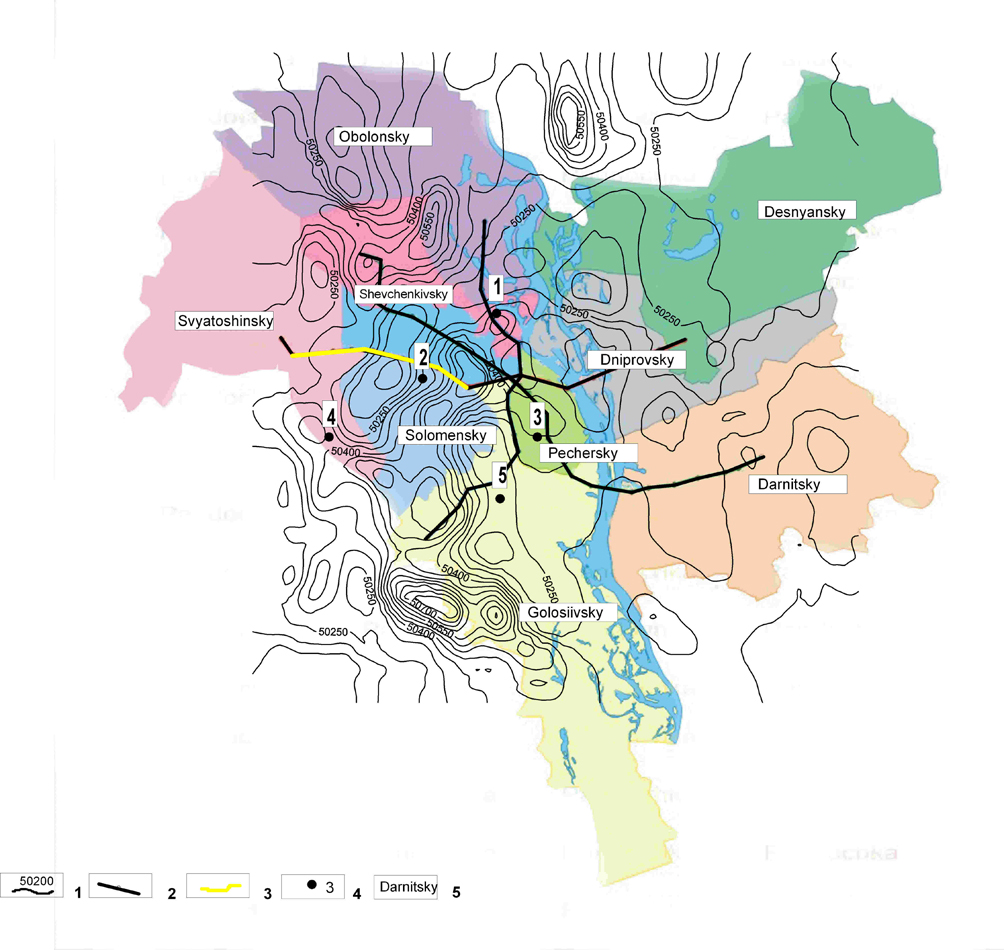
Fig.1 Kyiv map of scalar magnetic field B. 1- isolines of induction B. 2- metro route. 3- captured metro stations. 4- observation points. 5- regions of Kyiv.
The right riverside of the city (especially the old town) is mainly located in positive magnetic field areas with an intensity of 50-100 nT. The left riverside of the city is located in predominantly negative magnetic field areas (up to -200 nT). On the left riverside only Rusanivka, Bereznyaky and partly Kharkivskyi, Bortnychi areas are characterized by low positive background near 50 nT.
Another feature of the field is grouping of increased values in unique ovals, and grouping of low values - in linear zones of the north-west and north-east stretch. An interesting fact is some relation between building overgrowth and nature of the geomagnetic field [Orlyuk, Romenets. 2004].
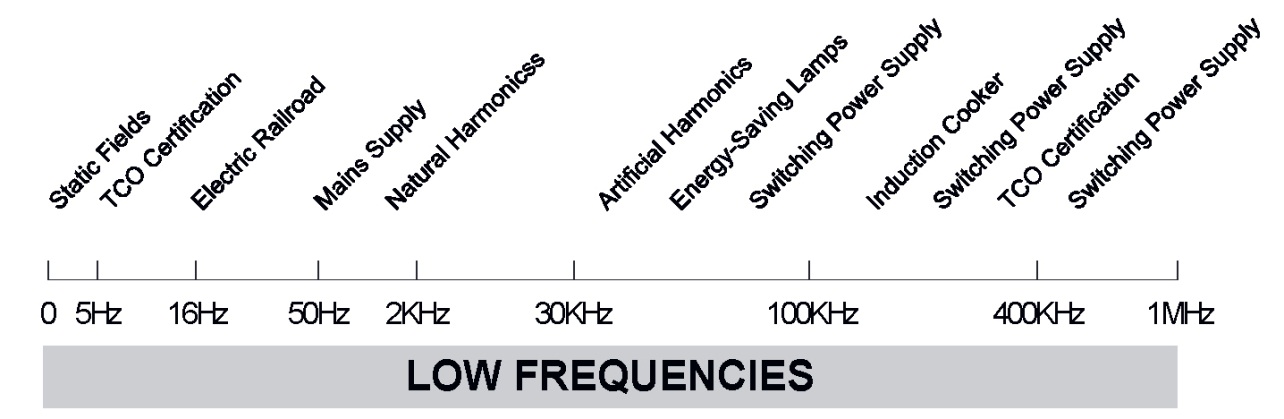
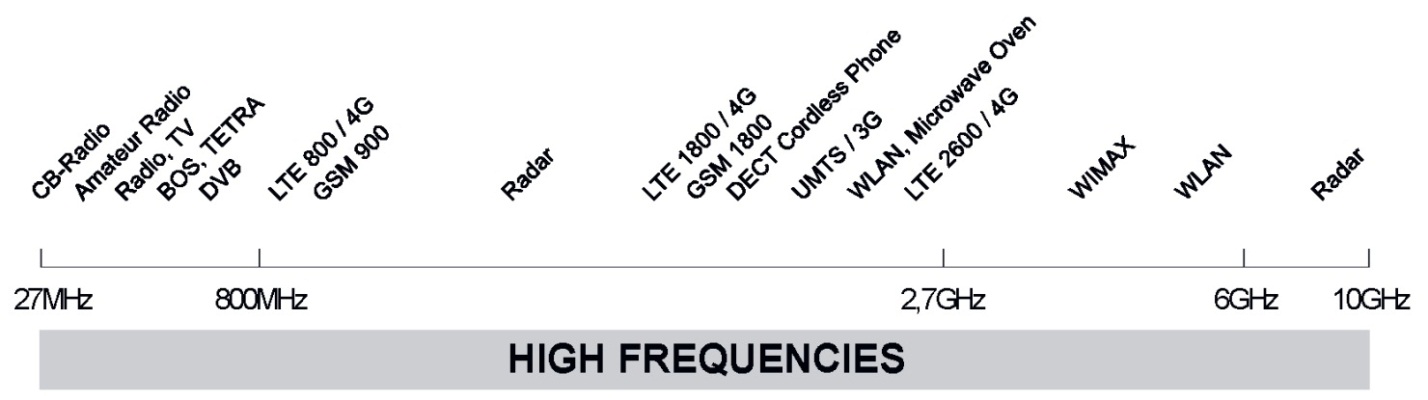
Variable magnetic (electromagnetic) field of natural and technogenic origin changes within 10-6 Hz – 10 GHz (Fig.2a).
a
b
Fig. - low frequencies range, b - high frequencies range.
Low frequency electric and magnetic alternating fields ("electrosmog"). This type of electromagnetic pollution is caused by home mains supply systems and by connected to them devices, by switches and lights, by high voltage lines, transformer stations and traction power.
High frequency radiation from 27 MHz to 10 GHz (Fig.2b), a range comprising frequencies from radio and TV (digital as well as analogue), TETRA (digital public safety networks), amateur radio, citizens band radio, microwave radio relay, mobile radio (GSM, GPRS, UMTS, LTE, CDMA, 3G, 4G), radar, DECT cordless telephones, Wi-Fi, WLAN, microwave ovens, WiMAX, and many more [www.gigahertz-solutions.de].
The greatest influence on technogenic electromagnetic noise at low frequencies (0,5 Hz - 400KHz ) is introduced by industrial frequency electric current users [Tjagunov.2011, 2012]. Otherwise, technogenic sources at frequencies of 10-6 - 1 Hz are the least explored and we explore it in our research.
The magnetic field at these frequencies may be associated with moving of ferromagnetic and electrical sources (cars, trams, trolleys, trains, electric trains and subway etc.), and some industrial processes which are using DC equipment, etc.
Trolley movement (motors turning on and off) causes a change of the magnetic field with an amplitude of about 80 nT at about distance from the road; 50 - 100 nT , caused by small magnetic masses movement (cars, vans, etc.); maximum amplitudes nearby 300 - 500 nT are caused by large trucks and urban electric transport[Tyagunov,2012]. It should be noticed that the presented above anomalous magnetic field levels are obtained at a distance of from the roadway and if measurements were made inside the vehicles, anomalous magnetic field level would be higher.
To study technological components of magnetic field magnetovariational station Lemi-008 was used [Korepanov at.al., 1999], and for intensive sources a portable magnetometer built-in smartphone on Android operating system(with special software) was used [Tab.1].
Tab.1 Equipment used
LEMI 008 – fluxgate magnetometer | YAMAHA YAS530 MS-3E high sensitivity 3-axis geomagnetic sensor. |
Measurable magnetic field range: | |
Range I 100 000 nT | Measurable magnetic field |
Range II 3 200.0 nT | range ±800 μT |
Resolution: | Magnetic field sensitivity |
Range I 10 nT | (X, Y) 0.15 μT/count |
Range II 0.1 nT | Magnetic field sensitivity |
Bandwidth of analog output DC - 1 Hz | (Z) 0.3 μT/count |
Smooth offset ranging band by each axis ± 1000 nT | Acquisition Time 1.5 ms |
Time of samples averaging 1s, 2s, 5s, 10 s, 60 s | Operating temperature |
Operating temperature range -5 to + | range to + |
Magnetic field variations measurements were made in 6 places, allocated more or less evenly within the of in industrial and utility rooms on the Palladina ave., , Harmatna, Bozhenka, Velyka Kiltseva and Vasyl'kivs'ka streets. The nature of magnetic field in the subway was also explored. According to theoretical and experimental studies, vertical component of the magnetic field Bz is the most sensitive to technogenic disturbance, increased values are explained by horisontal form currents from technogenic sources appearance on the Earth`s surface [Tjagunov 2011; Romenets, Orliuk, 2013].
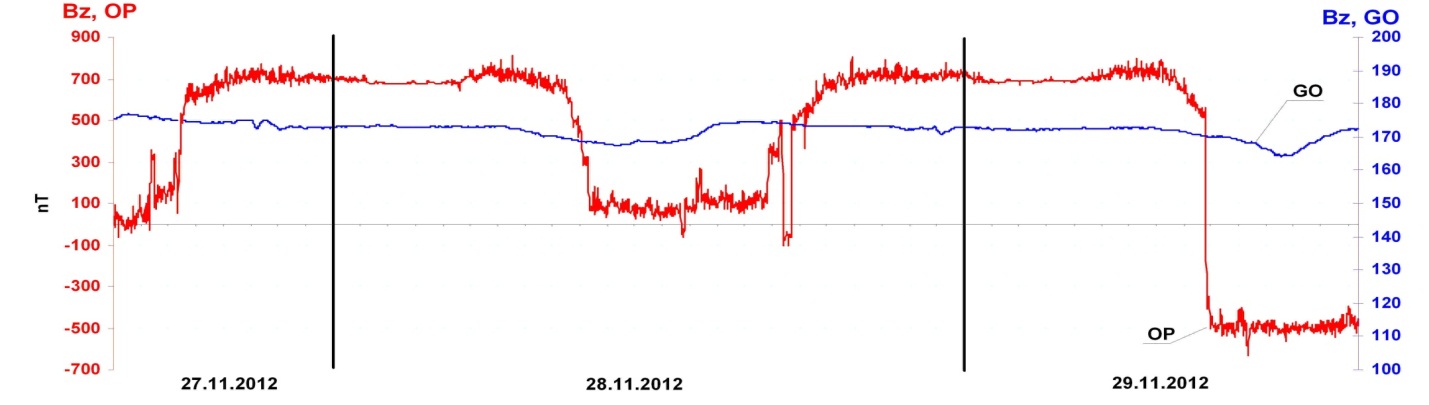
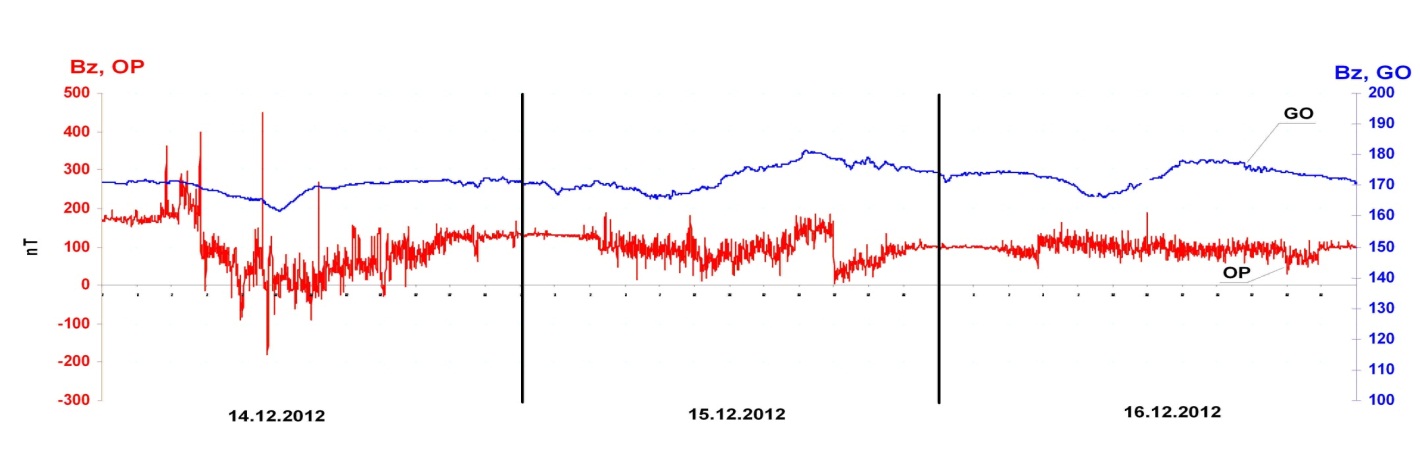
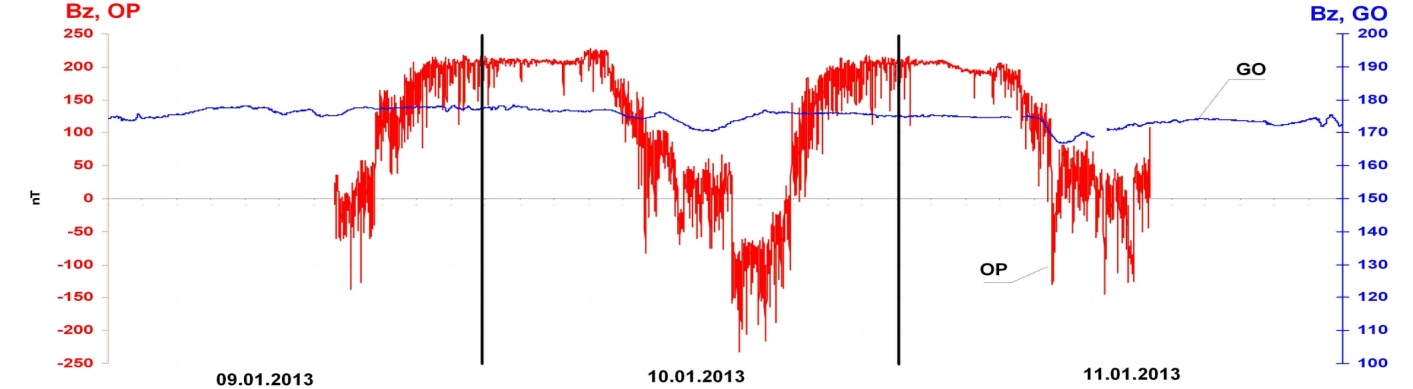
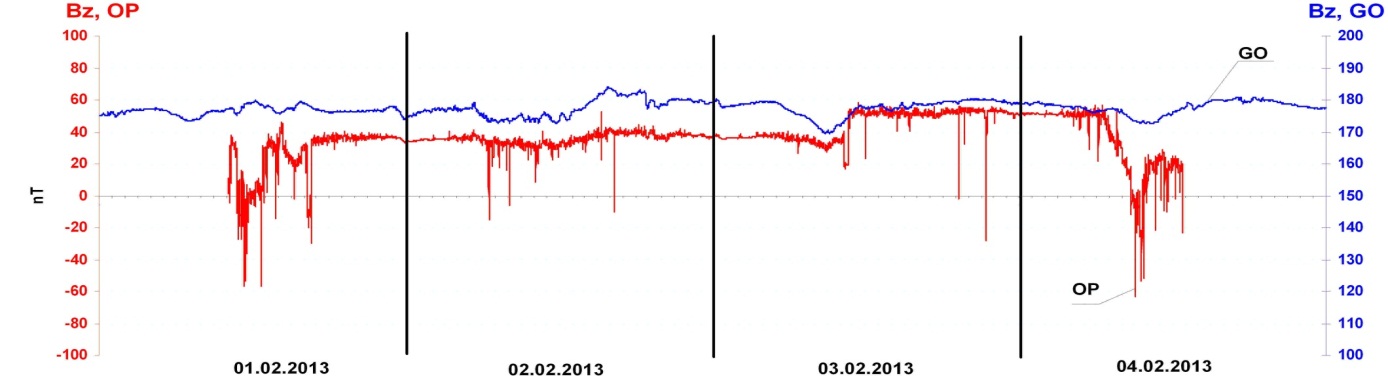
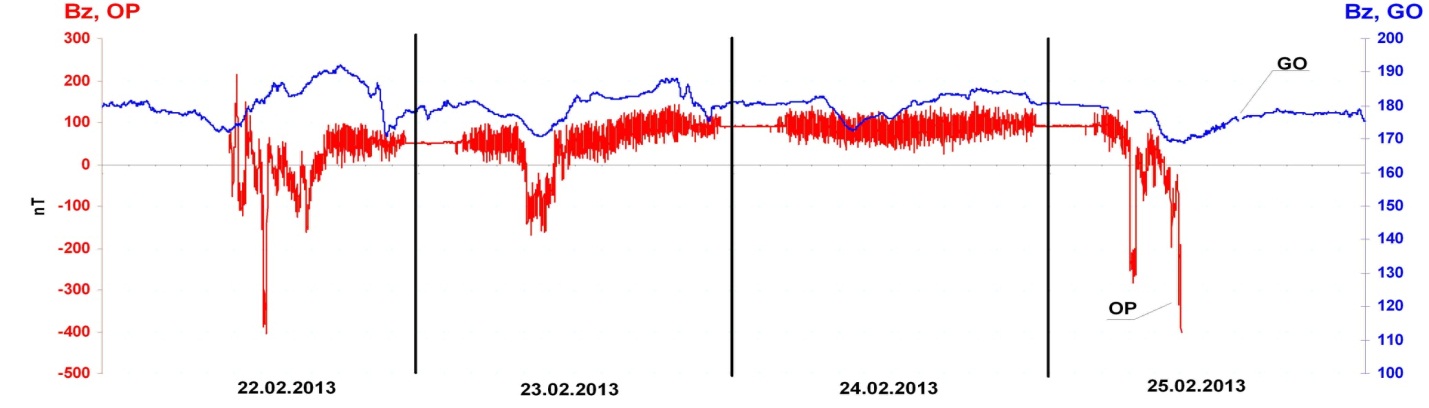
Magnetic field variations on observation points in comparison with geomagnetic observatory "" variations are shown on the graphs below (Fig.3).
 1
1
2
3
4
5
Fig 3. Results of measurements in observation point (OP): (1); (2); (3); Velyka kiltseva (4); Vasyl'kivs'ka street (5). GO - “Kyiv” geomagnetic observatory vertical component Bz variation (blue). OP – observation point vertical component Bz variation (red).
Observation point 1 ( 27-29.11.2012). Vertical component of the magnetic field ВZ has a sawtooth kind view, it indicates the presence of permanent mechanical or electromagnetic vibrations caused by the movement of cars and trams. The high-intensity magnetic field perturbations (300-500 nT) are caused, as it lately turned out, by the interference of slate production and more precisely by DC kilns working (Fig.3_1).
Observation point 2 ( 14-16.12.2012). Significant deviations from the normal level of geomagnetic field in the "" observatory are observed. 3 periods of it are allocated. During the daytime, when the B- component has a sawtooth kind form, indicating shows us the presence of permanent mechanical or electromagnetic vibrations. Most likely, they are caused by the movement of vehicles and strong traffic on the Peremogy ave. On this basis there are high-intensity (300-400 nT) and high-frequency magnetic field perturbations, previously associated with interference (most likely with on /off processes) DC converters, heaters, etc. At night, the magnetic field has generally calm nature (Fig.3_2).
Observation point 3 (Bozhenka street, 09-11.01.2013).Significant deviations from the normal level of geomagnetic field in the "" observatory with the amplitude of up to ~ 350 nT are observed. Three periods of magnetic field perturbations are clearly distinguished. The graph of the ВZ component of magnetic field has a sawtooth kind sinusoidal form that indicates the presence of constant electromagnetic interference. Probably they are caused by the work of some equipment at the Paton Electric Welding Institute). The proximity of intensive traffic flows (Bozhenka str., Fedorova ave.) makes influence on the overall noise character also. As in previous cases, registered high-intensity 100 ч 150 nT magnetic field perturbations are associated with the DC converters, etc. At night, the magnetic field has generally calm nature (Fig.3_3).
Observation point 4 (Velyka kiltseva 1 – 04.02.2013). Variations of the magnetic field don’t have any clear frequency, so it is suggested that the nature of their occurrence is random (turning on/off of any appliances, repairs, etc.). During all the observation period aperiodicity single "bursts" of up to 30 nT were registered. By their intensity they are not high and can be caused by reasons mentioned above. In the daytime, there are high-frequency magnetic field perturbations, but they are minor in intensity (10-15 nT). In general, excepting 2 periods of sporadic disturbances of magnetic field, it can be told that magnetic field in this observation point is approximately normal (Fig.3_4).
Observation point 5 (Vasyl'kivs'ka street, 22-25.02.2013) in the “Kyianka” factory basement. The highest level variations of technogenic origin were fixed at 250 - 600 nT. It should be noted that the abnormal value during 23-24 of February (weekend) is slightly lower than the 22 and 25 of February. Noticed deviations of magnetic field level have clear periodicity and it suggests their regular occurrence (most likely it is the effect from the subway). At night, the magnetic field has a quiet character and is not significantly different from the "" magnetic observatory data. The sawtooth kind high- intensity magnetic field perturbations to 150 nT are also recorded in the day time and it recognizes the "saturation" of these periods by various magnetic field noises (Fig.3_5).
Magnetic variations registration was conducted on the observation points in November-December 2012 - January-February 2013 for 2 - 3 days in each of them. As it is shown on the Figure, within magnetic field is significantly different from the results of magnetic observatory data that was captured from . 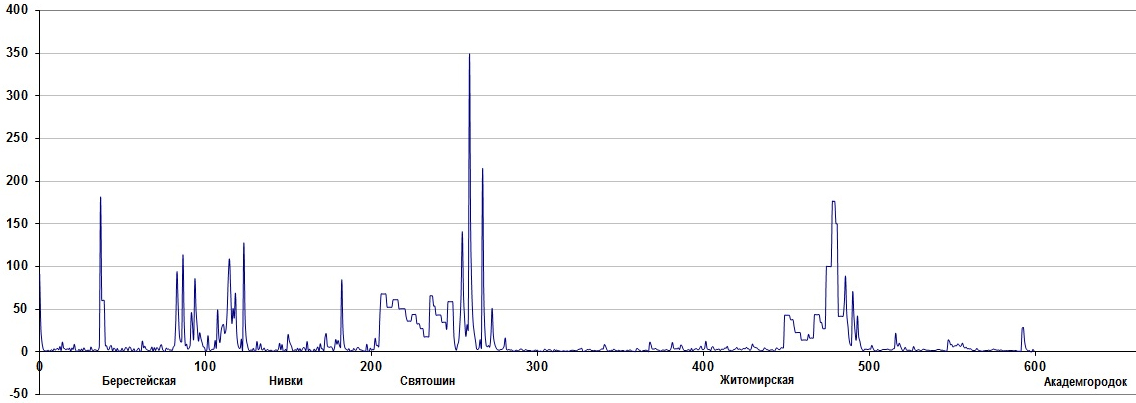
Fig.4. Magnetic noise scalar data captured between Beresteyska and Akademmistechko metro stations.
Measurements of geomagnetic field variations in the subway were made on the interval between Beresteyska and Akademmistechko metro stations (Fig.4). After processing the digital data it can be clearly seen all increased periods of magnetic induction. Peaks and periods of magnetic field increasing in the range of 40 - 350 mT at subway stations are seen on the graph. It is noticed that induction is primarily caused by motors located in the center of each wagon, and it shortly increases during the train acceleration. Besides of train motors, underground utilities, construction of subway tunnels and the ground-based infrastructure also producing magnetic noise. You can see from the graph; in the Svjatoshin zone a busy junction is located.
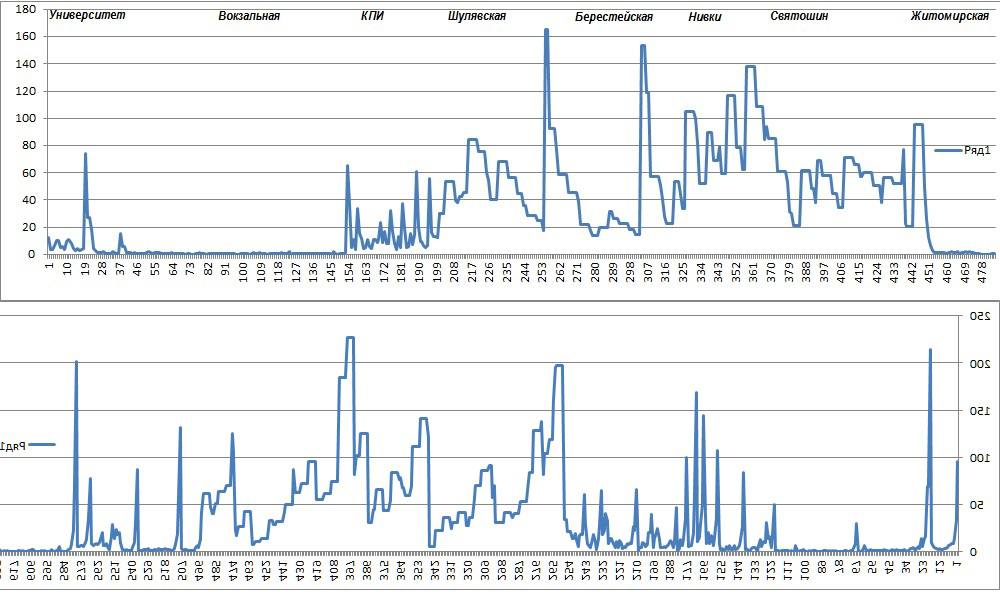
Fig. 5. Magnetic noise scalar data graphs captured between Universitet and Zhitomirska metro stations in direct and reverse directions.
Subway measurements of geomagnetic field variations on the interval between Universitet and Zhitomirska metro stations and in the reverse direction (Fig.5). After processing the digital data all periods of magnetic induction increase are shown. Between Beresteyska and Shuliavska stations we can see the anomaly of railway station. We can see that on the intervals such as Universitet – Vokzalna and Svyatoshin – Zhytomirska data on both graphs differs, it is explained by the inclination of the route lying(When a train goes up it uses a motor and when goes down the motor is turned off).
SUMMARY
For the natural geomagnetic field varies within 50100-50860 nT, increasing from southwest to northeast.
Technological different-period variations that are registered have amplitudes from tens to hundreds of nanoteslas and significantly differ from magnetic field variations on "" magnetic observatory. The highest values of induction B (up to 100-350 μT) are registered in the subway, while train accelerates and slows down; technogenic variation sources have in most cases electrical and ferromagnetic origin, and are associated with turning on/off and working of direct current sources, movement of electric transport including the subway, and mechanical movement of different kinds of vehicles;
Noticeable daily rhythm of technogenic sources is proven by people operating mode and manufacturing.
We can say that people are always under influence of light it follows that technogenic magnetic perturbations can effect on the living organisms as well as a strong magnetic storm.
References
Belokrinitskiy V.S. What do mobile phone users must know? - K. - University "" -2009. –112p. (in rus).
Physical factors of the working environment. Sanitary-epidemiological rules and norms. SanPiN 2.2.4.1191-03 " Electromagnetic Fields and Human Health " . - M. -2003. – 19p. (in rus).
Gvishiani A.D., Solov'yev A.A., Agayan S.M., Bogoutdinov SH.R., Sidorov R.V. Magnetogramm algorithmic system of emission recognition / / Earths physical fields dynamics. - M. Svetoch Plyus, 2013. - S .297-310. (in rus).
Jerzy Jankowski. Pigeon naviagation model based on vector magneometer// Przeglad geofizycny.—2010, Rocznik LV, Zeszyt 3-4.—S. 157-174.
Khramov A.V. Dinamika proizvodstvennogo travmatizma v zone Kurskoy magnitnoy anomalii i deystviye kosmofizicheskikh faktorov / A.V. Khramov , V.YU. Serpov , O.I. Shumilov , A.S. Stepanova / / Vestn . novykh med . tekhnologiy - . 2006 - . № 3 - . S . 174-176. (in rus).
Korepanov V . , Berkman R . , Best A . , Lнnte G.-Y. , Mar'yanyuk YA . , Reda YA . , Payunpaa K . , Rakhlнn L . Yeksperimental'nн doslнdzhennya stabнl'nostн ferozondovikh magnнtometrнv , Ukraн̈ns'kiy metrologнchniy zhurnal , 1999, vipusk 3 , s . 23-25. (in rus).
Kulikov V.YU. Timofeyeva Ye.S. Otsenka sochetannogo vliyaniya razlichnykh variatsiy geomagnitnogo i radiatsionnogo poley na osmoticheskuyu rezistentnost' eritrotsitov cheloveka v usloviyakh in vitro na / / Meditsina i obrazovaniye v Sibiri " . -2011 . - № 4 . - S.12 -20. (in rus).
Medvedeva O.A. , Kalutskiy P.V. , Besedin A . V . , Medvedeva S.K. , Kalutskiy A.P. Ekologo - epidemiologicheskiy analiz zabolevayemosti detskogo naseleniya kishechnymi infektsiyami v regionakh Kurskoy oblasti s razlichnym urovnem geomagnitnogo polya / / Nauchnyye vedomosti . Seriya Meditsina.Farmatsiya. -2011 - . № 10 ( 105 ) - S.5 -11. (in rus).
Orlyuk M.I. , Romenets A.O. Magnнtne y ekologнchne pole megapolнsu ( na prykladн m . Kyeva) / / Ekologнya н pryrodokorystuvannya . - 2004 . - Vypusk 7 . - S . 142-147. (in ukr).
Orlyuk M.I. Geofнzychna yekologнya - osnovnн zadachн ta shlyakhi н̈kh rozv'yazku / / Geofizich . zhurn. -2001 . - t.23 . , № 1.- S.49 -59. (in ukr).
Orlyuk M. I., Romenets A. A., Orliuk I.M. Technical low-frequency magnetic noise in / / Dopovidi NAS of . – 2014. – N 3. 110p. (in rus).
Pavlovich N.V. , Pavlovich S.A. , Galliulin Y.I. Biomagnetic rhythms - Mn: Universitetskoye , 1991. - 136p. (in rus).
Rezinkina M.M. , Pelevin D.Ye. , Dumanskiy YU.D. , Bitkin S.V. Oslableniye geomagnitnogo polya v mnogokvartirnykh domakh razlichnykh proyektov / / Gнgнкna naselenikh mнsts'. - 2009 - . № 54.-S. 209-216. (in rus).
Romenets A.A., Orliuk I.M. Monitoring i analiz nizkochastotnogo tekhnogennogo shuma v g.Kiev //Geodinamika. – 2013. - №2(15). – S. 314-316. (in rus).
Serpov V.YU. Vliyaniye yestestvennykh magnitnykh poley na bezopasnost' zhiznedeyatel'nosti cheloveka v zonakh geofizicheskikh anomaliy Yevropeyskoy chasti Rossii . Avtoreferat dissertatsii na soiskaniye uchenoy stepeni doktora meditsinskikh nauk po spetsial'nosti 14.00.07 - Gigiyena . St – Peterburg - 2007. (in rus). Travkin M.P. Zhizn' i magnitnoye pole / - . Izd - vo Belgorodskogo ped. i-ta. - 1971.-192s. (in rus).
Tyagunov D.S. Tekhnogennoye elektromagnitnoye pole kak ekologicheskiy faktor / / Ekologiya urbanizirovannykh territoriy . - M . -2011 . - № 2. - S . 45 - 50. (in rus).
Tyagunov D. S. Prostranstvenno- vremennyye kharakteristiki gorodskogo tekhnogennogo magnitnogo shuma v chastotnom diapazone 0,01-30 GTS. Avtoreferat dis.kand.tekhn.nauk. Yekaterinburg, 2012.-20s.
ICNIRP Guidelines. Guidelines for limiting exposure to time-varying electric, magnetic, and electromagnetic fields (up to 300 GHz// Health Physics.-1998.-- 74 (4):494-522;